Start with the inside footprint.
Measure the inside length and the front-to-back width of the floor you will fill. Keep the ruler straight and record the unit beside each number.
The gallon label is a useful description of a tank. It does not give every tank with that label the same floor. Check the glass-to-glass footprint, or a reliable dimensional drawing, before using a preset as your shopping quantity.
If you cannot verify an inside measurement, keep a note of the uncertainty. Subtracting a guessed glass thickness produces a tidier number, not a better measurement.
Give the bed a defined shape.
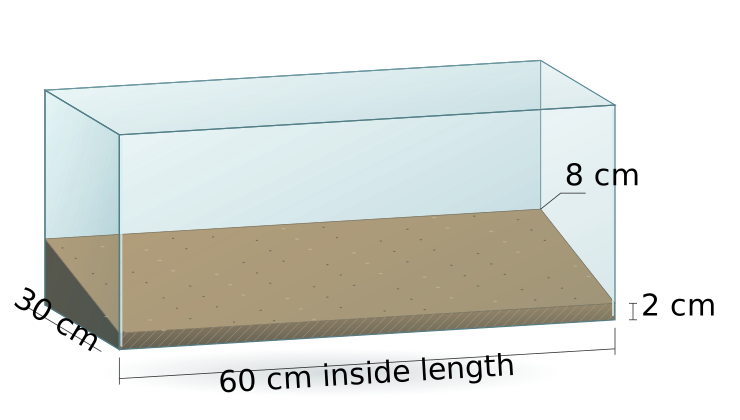
A flat bed has one depth. An even front-to-back slope has two, so use their average. Two centimeters at the front and eight at the back average five centimeters.
That can be hard to see in a planted tank. The rear bank looks generous; the shallow front balances it. Try both shapes below, then move one end and see exactly what changes.
An even 2-to-8 cm slope averages 5 cm. The same volume as a flat 5 cm bed.
Drag the depth markers, or use the sliders.
Bed geometry is proportional. Glass height is illustrative.
How do I choose an actual depth?
Start with the material’s job and its current instructions. A complete bed and a concentrated layer under gravel are different plans.
- Tropica Aquarium Soil ↗ is a complete substrate. The maker uses an 8 cm depth in a volume example; that is an example, not a depth rule for every aquarium.
- Tropica Plant Growth Substrate ↗ is specified as a 1 cm nutrient layer beneath gravel. That 1 cm is one layer, not the complete gravel-covered bed.
Check the exact product, planting plan and needs of the intended inhabitants before settling on a depth. For a layered system, calculate each material separately.
Manufacturer instructions checked November 9, 2026. The movable geometry examples demonstrate quantities, not recommended care settings.Average depth = (front + rear) ÷ 2
Turn the measurements into liters.
Length × width × depth gives cubic centimeters when all three measurements are in centimeters. Divide by 1,000 to get liters. A 60 × 30 cm floor with a 5 cm average depth needs 9 liters.
Tropica uses this volume method in its Aquarium Soil guidance. The unit definitions come from NIST. If you work in inches, each inch converts to exactly 2.54 cm; the calculator keeps that precision until the result is displayed.
A 20 × 10 inch footprint at 2 inches deep is 6.5548256 liters. Keep the full result for the later bag calculation, even if the number on screen is shorter.
Volume (L) = internal length (cm) × internal width (cm) × average depth (cm) ÷ 1,000
| Input | Flat example | Sloped example |
|---|---|---|
| Inside footprint | 60 × 30 cm | 60 × 30 cm |
| Front / back depth | 5 / 5 cm | 3 / 7 cm |
| Average depth | 5 cm | 5 cm |
| Base volume | 9.00 L | 9.00 L |
Keep adjustments separate from the base volume.
A stone occupying part of the bed leaves less space for substrate. A mound or terrace changes the shape. This rectangular model cannot infer either from a photograph.
Keep the base calculation separate from any extra you choose. Ten percent added to 9 liters gives 9.9 liters. Whole-bag rounding happens afterward, so you can see what each decision added.
Do the bag calculation last.
Once the volume makes sense, read the pack. Liter-labeled quantities compare directly. A kilogram quantity needs a supported bulk density before it can become a volume-based bag count.
Buying a larger pack may leave more spare material. Compare the amount supplied as well as the number of bags. The next field note walks through those unit and rounding decisions.
Check these three things, then calculate.
Check the inside footprint, your units and the bed shape. Then enter your own numbers.
Choose the actual depth for your setup. The shapes here explain the arithmetic; the calculator does not choose a substrate material or care depth for you.
Method: a rectangular footprint with a flat bed or an even linear slope. Glass height in the interactive drawing is illustrative. Hardscape, irregular mounds and material packing can change the actual amount. Unit definitions and the volume method are linked below.
- NIST: SI units for volume ↗A liter is a cubic decimeter; a milliliter is a cubic centimeter.
- NIST: conversion factors ↗The inch-to-centimeter conversion factor is exactly 2.54.
- Tropica: Aquarium Soil calculation ↗The manufacturer's volume method multiplies centimeter length, width and thickness, then divides by 1,000.
- Tropica: Plant Growth Substrate ↗The product instructions specify a 1 cm nutrient layer under gravel; this is not the full bed depth.