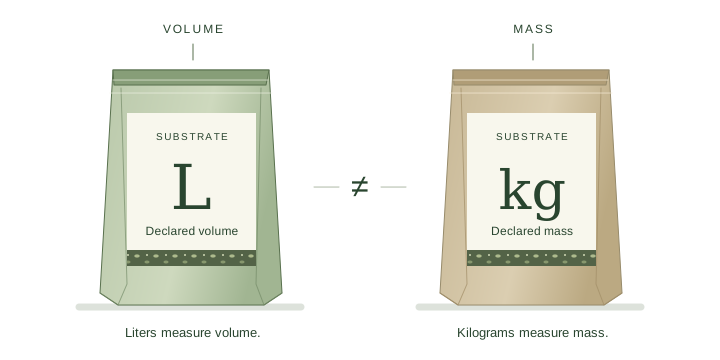
Read the unit before the number.
A 5-liter bag describes volume. A 5-kilogram bag describes mass. The printed number alone cannot tell you whether either covers a 9-liter bed.
With a liter-labeled pack, compare volumes directly. If the label provides both mass and volume, check that both belong to the exact product and pack in your hand.
Use a relevant bulk density for kilogram bags.
Bulk density connects a quantity of grains to the space they occupy, including the gaps between them. The density of the solid mineral alone is a different thing.
Use a manufacturer declaration or a documented measurement that matches the product and condition. Without one, you can still plan in liters and ask the supplier for the missing relationship.
For the arithmetic, 3 liters at 1.5 kg/L weighs 4.5 kilograms. The density in that example is an assumption, not a value assigned to every sand, gravel or aquasoil.
Weight (kg) = required volume (L) × bulk density (kg/L)
Carry a range through to the bag count.
A range should stay a range. At 1.2 to 1.6 kg/L, 9 liters corresponds to 10.8 to 14.4 kilograms. Four-kilogram packs then require three to four bags.
Using only the midpoint hides the extra bag at the upper end. Carry the range through, and check its source before settling on a purchase.
| Hypothetical input | Lower estimate | Upper estimate |
|---|---|---|
| Required volume | 9 L | 9 L |
| Bulk density | 1.2 kg/L | 1.6 kg/L |
| Calculated mass | 10.8 kg | 14.4 kg |
| 4 kg bags, rounded up | 3 bags | 4 bags |
Round the result, not the inputs.
Round the bag count, not the measurements. Exactly 10 liters fits into two 5-liter packs. Just over 10 liters needs a third.
Move the requirement below. The volume changes smoothly; the bag count moves in steps. A smaller pack may reduce the spare, although price and product suitability still need their own comparison.
5-liter packs
2 bags1.0 L left over
3-liter packs
3 bags0.0 L left over
At 9 liters, both options cover the bed. The smaller pack leaves less spare.
Example volume packs. Price and product suitability are separate decisions.
Whole bags = required amount ÷ quantity per bag, rounded upward
Check the exact product format.
Real labels make the distinction concrete. Fluval’s US Stratum page listed 2, 4 and 8 kg selections when checked on November 9, 2026. Seachem’s Flourite material listed 3.5 and 7 kg formats.
Those figures tell you the pack mass. Check the current SKU, regional label and any volume or bulk-density information before turning one of them into a bag count.
Compare the whole purchase.
A price belongs to a specific pack. Three to four bags at $10 each gives a $30 to $40 subtotal. A known $5 shipping charge makes that $35 to $45.
Keep an unresolved delivery charge separate from the subtotal. Take the quantity, exact product, likely spare and open questions into the shopping checklist.
Pack formats were checked against the linked manufacturer pages on November 9, 2026. Density, pack-volume and price examples are mathematical illustrations. They are not product measurements, live offers or recommendations.
- NIST: SI units for volume ↗Liter and cubic-measure definitions support keeping volume separate from mass.
- Fluval US: Stratum ↗The official US page listed 2 kg, 4 kg and 8 kg product selections on the checked date.
- Seachem: Flourite ↗Official product material identified 3.5 kg and 7 kg formats on the checked date.