How do plants help fish feel sheltered?
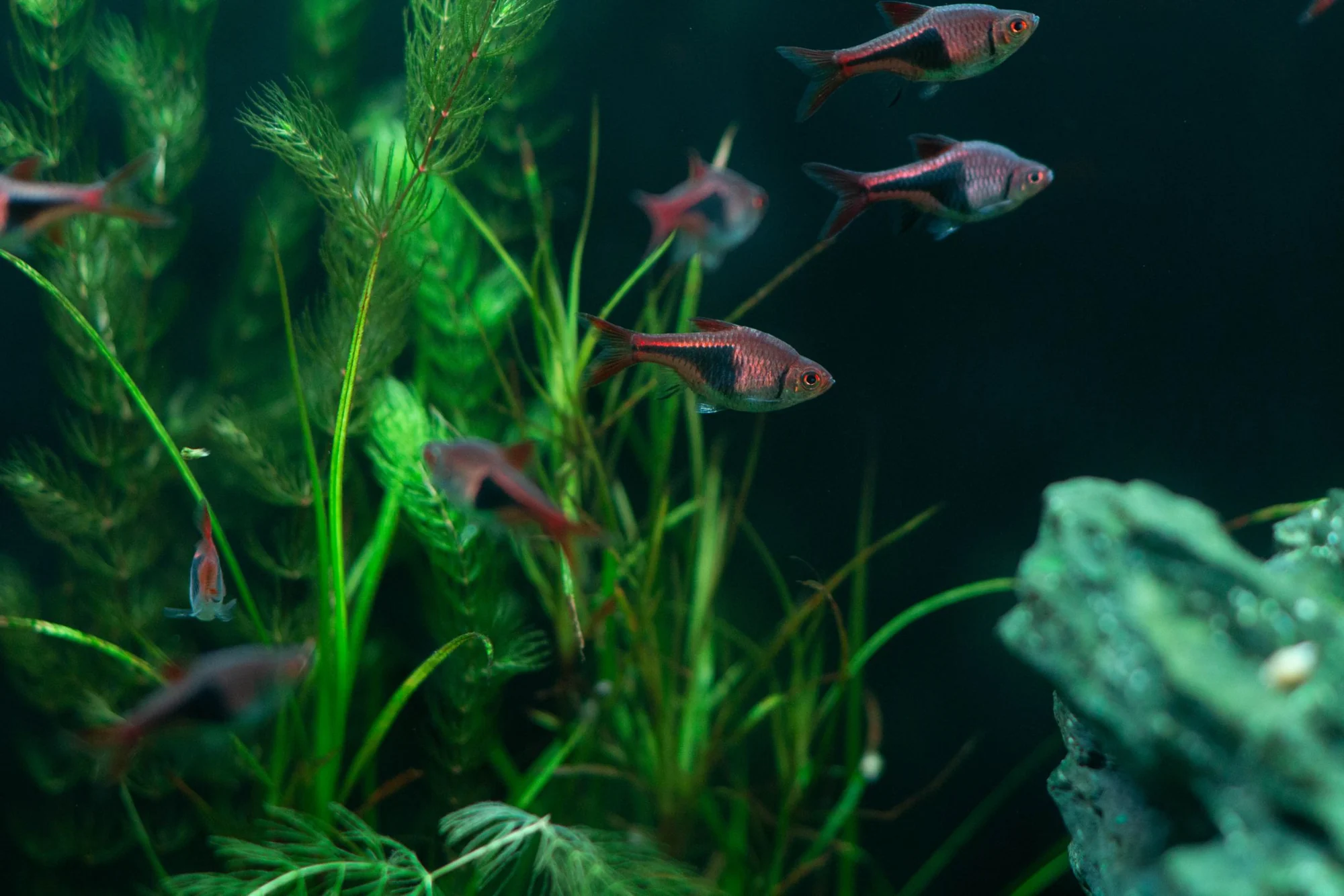
Leaves and stems can create shade, visual cover and places for fish to explore. The RSPCA describes plants as one way to add shelter and enrichment to an aquarium. Different fish use their space differently, so choose cover that suits the species rather than filling every open area with vegetation.
Leave swimming room and access for maintenance. Plants do not make incompatible fish safe to keep together, and some fish may uproot or eat particular plants. Check each animal's needs before choosing the layout.
Sources: RSPCA ↗
Do live plants remove nitrate?
Growing aquatic plants can take up nitrogen compounds, including nitrate, as nutrients. How much they use depends on the plants, their growth and the conditions in that particular aquarium. A few plants do not guarantee a safe nitrate reading.
Keep testing the water and follow a maintenance plan appropriate to the aquarium and its animals. Waste production, feeding and the source water matter too. UF/IFAS notes that nitrate can accumulate in closed systems and that water changes or other specific methods may be needed to remove it.
Sources: UF/IFAS ↗
Do plants add oxygen at night?
Plants can release oxygen during photosynthesis when they receive suitable light. They also respire and use oxygen. In darkness, photosynthesis stops while respiration continues, so a planted aquarium should not be assumed to have extra oxygen around the clock.
Maintain appropriate surface movement and aeration for the animals and equipment in your tank. If fish are gasping, promptly improve aeration or surface movement without overwhelming fish that need gentle flow. Check water quality and seek qualified aquatic advice. A planted layout is not a substitute for investigating the cause.
Sources: University of Missouri Extension ↗ Oklahoma State University ↗ UF/IFAS ↗
Can plants replace the filter or cycling?
Do not assume that adding plants makes a new aquarium ready for fish or makes its existing filtration unnecessary. Fish produce ammonia, and the biological filter depends on microorganisms that process nitrogen waste. Keep the filter and the established care routine appropriate to the aquarium.
For a new setup, understand the aquarium nitrogen cycle and use a suitable fishless cycling method before stocking. Follow the chosen method and the actual product instructions; do not add an ammonia source to an aquarium containing animals.
Will plants prevent algae?
Plants and algae can use overlapping resources, but plants are not an algae-proofing treatment. Light, nutrients, growth and maintenance interact, and an aquarium can have both healthy plants and algae.
Start with lighting suited to the plants you choose, remove decaying material, and make changes gradually while observing the result. Oklahoma State University's water-garden guidance discusses plant nutrient uptake and algae in ponds; it does not promise the same outcome in every aquarium.
Sources: Oklahoma State University ↗ Tropica ↗
What should I check before adding plants?
Choose species that fit the tank's light, water, space and inhabitants. Inspect new plants and ask a knowledgeable aquatic veterinarian or aquatics specialist about an appropriate quarantine process. UF/IFAS notes that plants moved between fish systems can carry the organism that causes ich; risk and holding time depend on the situation.
Check local sale and possession rules for the exact species. Never release aquarium plants or fragments into waterways or drains. Follow local disposal instructions. For example, Hennepin County advises sealing filtered plant fragments in a bag, freezing them for 24 hours and putting them in the trash.
Sources: UF/IFAS ↗ Hennepin County ↗
Do I need special soil or injected CO₂?
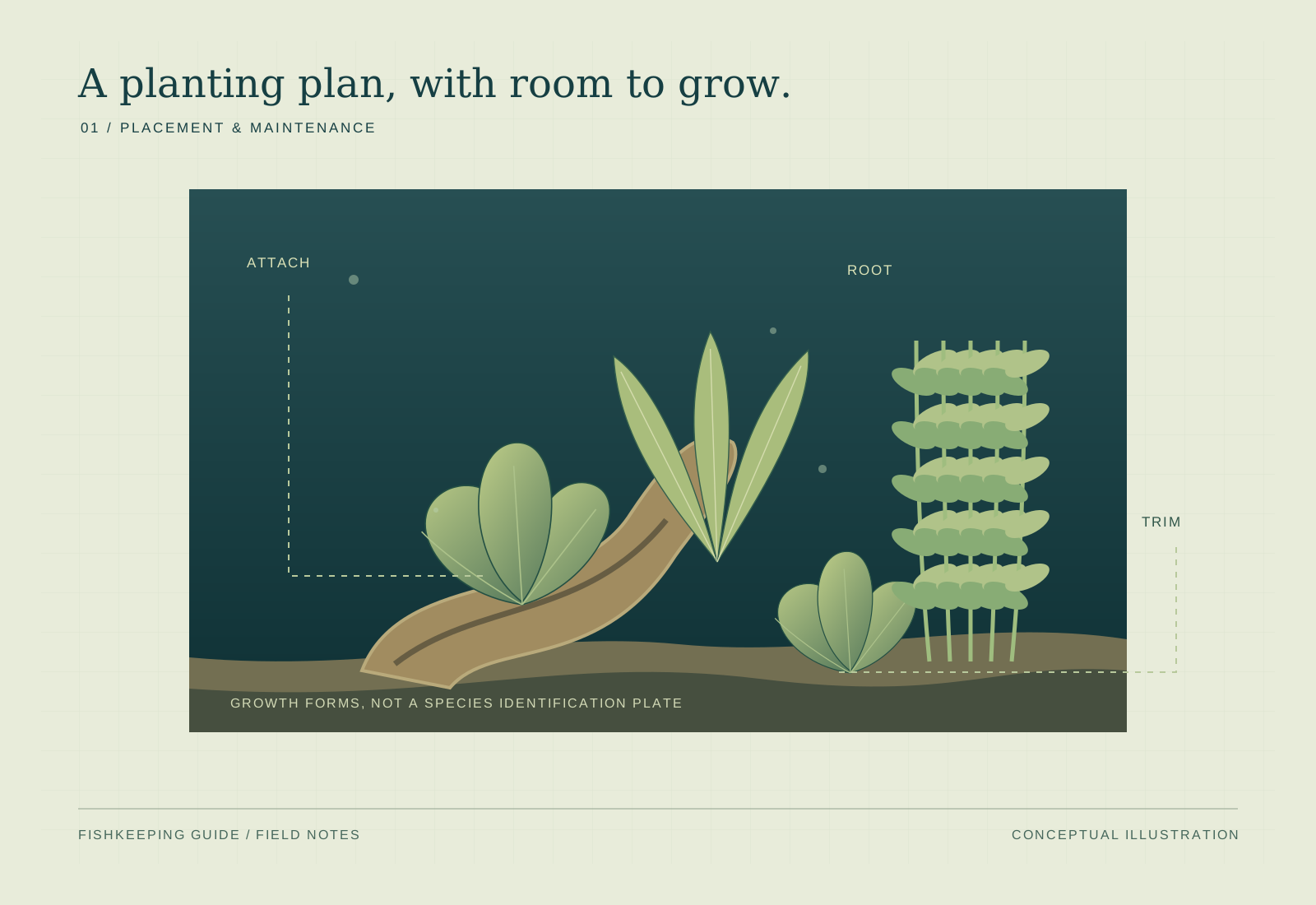
Not every planted aquarium needs the same equipment. Some plants attach to wood or rock rather than rooting in a soil bed; others need suitable root conditions. For example, keep the thick rhizome of an Anubias above the substrate when attaching it to hardscape.
Light, nutrients and carbon still matter, and a low-demand label does not guarantee success in every setup. Start with a few plants suited to your conditions. Our beginner aquarium plants guide compares attached, rooted and background choices and their maintenance tradeoffs.
This guide was drafted and checked against the linked animal-welfare, university extension and plant-care sources with AI assistance. It has not received an independent expert review and does not claim an aquarium experiment or a guaranteed water-quality result.
- RSPCA: Fish behaviour and enrichment ↗Plants, shade and shelter can support an enriched aquarium environment.
- UF/IFAS: Ammonia in aquatic systems ↗Nitrification, plant uptake of nitrate and nitrate accumulation in closed systems.
- UF/IFAS: Responsible aquarium fish ownership ↗Filtration, water quality and quarantine as parts of responsible aquarium care.
- UF/IFAS: Ich infections in fish ↗Plants and equipment can introduce ich between fish systems; risk reduction depends on the life cycle and conditions.
- UF/IFAS: Fish health in recirculating systems ↗Improved aeration and water-quality checks are among responses to low dissolved oxygen.
- Oklahoma State University: Water gardens ↗Plant photosynthesis, nighttime respiration and nutrient/algae dynamics in water gardens; not an aquarium-specific trial.
- Tropica: Planting aquarium plants ↗Different plant types have different planting and attachment needs.
- Tropica: Anubias barteri var. nana ↗Anubias can be attached to hardscape; its rhizome should not be buried.
- Tropica: Aquarium light ↗Plants need suitable light and requirements vary.
- University of Missouri Extension: Pond water quality ↗Photosynthesis raises oxygen during daylight while respiration continues at night in aquatic systems.
- Hennepin County: Aquatic invasive species prevention ↗Safe handling of aquarium plant fragments and avoiding release into waterways.