Choose the job before the plant
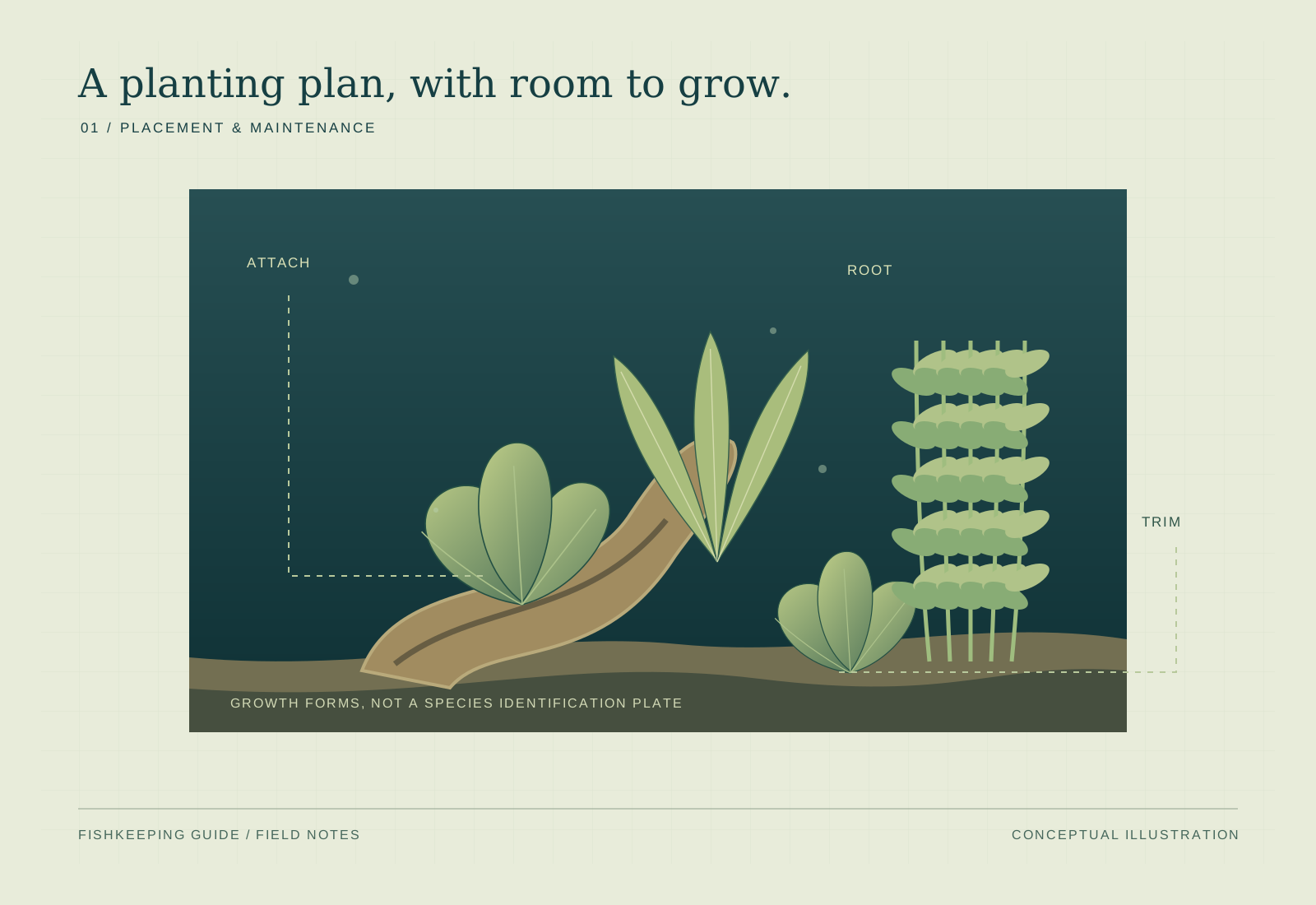
The table separates placement from maintenance. Sizes and growth change with conditions, so use the individual profiles to check the exact plant sold.
| Plant | Planting job | Main commitment |
|---|---|---|
| Anubias barteri var. nana | Compact leaves on wood or rock | Keep rhizome exposed; watch slow-growing leaves |
| Microsorum pteropus | Taller attached fern | Allow height; divide the rhizome |
| Taxiphyllum barbieri 'Bogor Moss' | A textured patch on hardscape | Trim and collect loose fragments |
| Cryptocoryne wendtii 'Green' | Rooted midground rosette | Allow space for the rosette |
| Bacopa caroliniana | A background group of stems | Cut and replant as it grows |
| Helanthium tenellum 'Green' | A low, spreading foreground | Support roots and control runners |
| Echinodorus grisebachii 'Bleherae' | A large solitary backdrop | Reserve room and manage shade |
Sources: Tropica ↗ Tropica ↗ Tropica ↗ Tropica ↗ Tropica ↗ Tropica ↗ Tropica ↗ Tropica ↗ Tropica ↗
Build a layout you can still reach
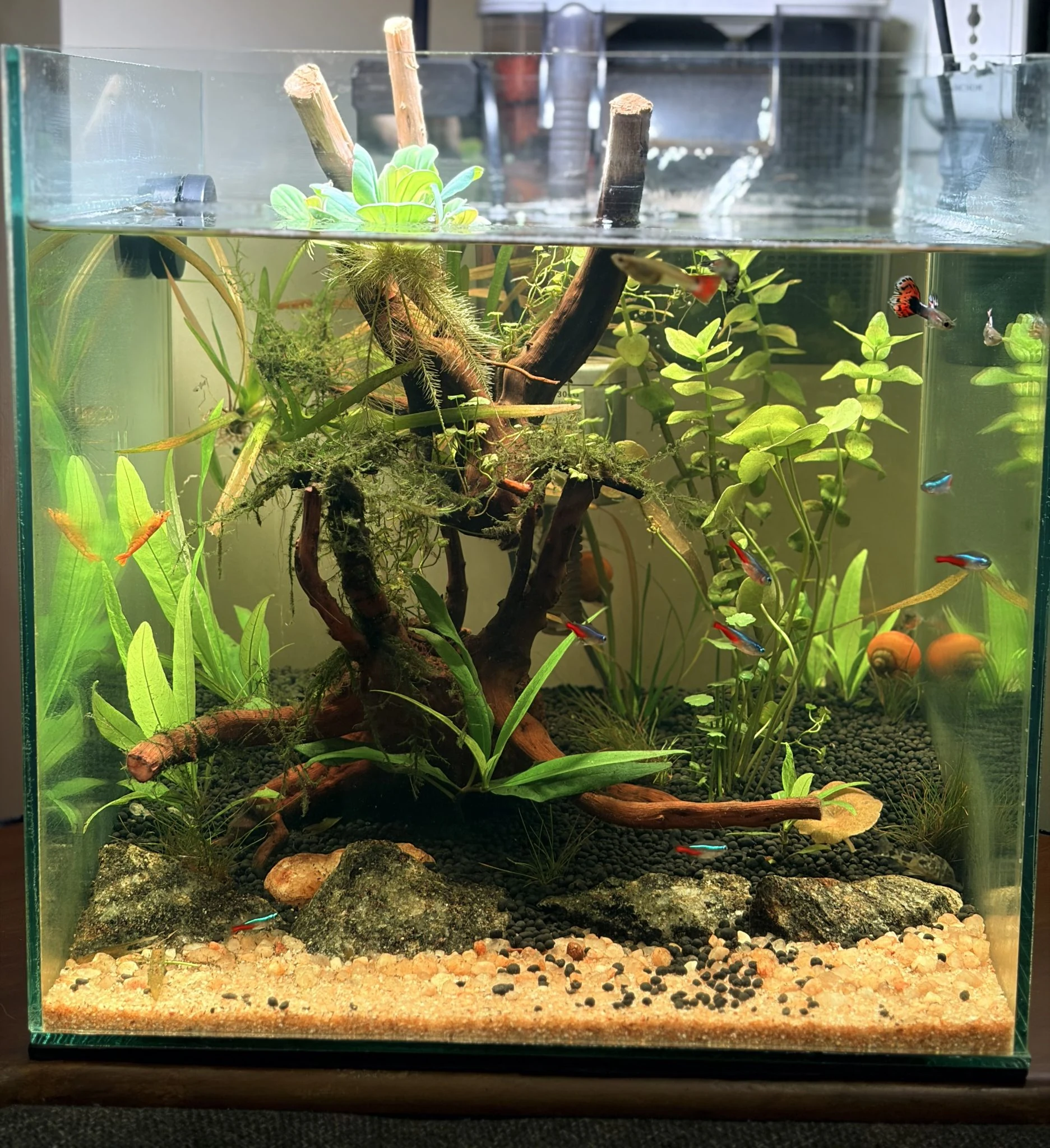
Put a compact attached plant on a front-facing piece of wood or stone. Place a fern farther back, with room for its leaves. Use one rooted rosette beside the hardscape and a stem group behind it. Leave an accessible area for cleaning and replanting. This is a placement pattern, not a requirement to buy all seven.
Choose between a spreading foreground and open substrate according to your maintenance plans. The large sword is an alternative focal plant for a roomy aquarium, not an automatic addition to this layout. Check tank volume and the actual height and footprint before buying it.
Prepare plants according to their supplied format. Remove pots and packing material as directed; separate stem portions instead of burying a tight bundle. Attach rhizome plants and small moss portions to hardscape. Plan enough access to lift out cuttings without dismantling the aquarium.
1. Anubias barteri var. nana: a compact hardscape plant
Use this for broad leaves close to the foreground without planting into the bottom. Tropica describes the plant reaching roughly 5–10 cm in height, carried by a spreading rhizome. Secure it to wood or stone until its roots grip.
The rhizome is the thick horizontal growth carrying the leaves. Keep it above the substrate; burying it risks rot. Its slow growth suits someone who wants infrequent reshaping, but also gives algae time to settle on long-lived leaves. A shaded position can work. Pass if you want a fast-growing screen or intend to bury every plant in gravel.
2. Microsorum pteropus: height without a rooted bed
Java fern gives wood or rock a taller leafy outline. Tropica lists this fern at about 15–30 cm, so allow space above and behind it rather than treating a small purchase as its final size. Attach the plant with its rhizome exposed.
It suits a layout needing midground height where the substrate is unsuitable for rooted plants. Divide the horizontal rhizome when a clump needs splitting. Black spots on the undersides of leaves can be reproductive structures called sporangia, so that appearance alone does not establish disease. Choose something smaller if the available gap cannot accommodate the fronds.
Sources: Tropica ↗
3. Taxiphyllum barbieri 'Bogor Moss': texture that needs boundaries
A small moss patch softens a branch or stone without introducing another large leaf shape. Check the botanical label: this selection is Taxiphyllum barbieri sold as 'Bogor Moss', rather than an assumption that every product called Java moss is identical.
Attach small portions until they hold. Tropica describes a mat that can become 3–10 cm thick and recommends scissors when growth becomes too lush. Trim for the shape you want, then collect the loose pieces. It fits someone willing to do small, regular grooming. Skip a large moss covering if you want a permanently crisp outline without that work.
4. Cryptocoryne wendtii 'Green': a rooted midground rosette
This is the rooted leafy clump in the palette. Give each rosette space in the substrate instead of tying it to wood. Tropica describes a height of about 10–30 cm and a rosette roughly 8–15 cm wide, with size depending on the aquarium.
An open position can produce leaves lying closer to the bottom, so do not rely on a perfectly upright screen. It suits a keeper who wants an individual midground plant and can leave space around its leaves. Remove damaged or yellowing leaves; thin an overcrowded group by removing whole plants. Rule it out where you need a consistently tiny foreground.
5. Bacopa caroliniana: stems you can shorten and replant
Plant Bacopa as a small background group, with individual stems set into the substrate. It supplies a vertical structure that the attached plants cannot. Do not treat the profile's initial height as a permanent ceiling: Tropica's separate growing guide describes substantially taller growth over time.
When it becomes too tall, trim stems and replant suitable tops or side shoots; the remaining stems can make new shoots. This makes it useful for someone comfortable with periodic rejuvenation rather than preserving every stem untouched. Allow light to reach the group. A shallow aquarium with no appetite for cutting and replanting is a poor match.
6. Helanthium tenellum 'Green': a conditional foreground
This small rosulate plant spreads through runners. Plant it in the foreground when you want a living low layer rather than a single accent. It was previously named Echinodorus tenellus 'Green', which can help when comparing labels.
The important qualification is in Tropica's description: a dense, low carpet depends on good light and a nutritious bottom. An easy rating does not promise a lawn under a shaded overhang. Remove runners that cross into spaces reserved for other plants. Choose it if you can support root nutrition and manage spreading growth; leave it out if an immediate, maintenance-free carpet is the goal.
7. Echinodorus grisebachii 'Bleherae': the space-demanding specimen
Use this sword as a solitary rooted focal plant toward the back of a roomy aquarium. Tropica describes growth reaching about 20–50 cm and specifically places it in larger aquariums. A nutritious bottom supports its growth.
The tradeoff is the canopy: a successful specimen can shade the smaller plants you chose first. Remove outer or shading leaves as needed, rather than expecting the foreground beneath it to remain equally bright. It suits a layout designed around one substantial plant. Rule it out when the aquarium's height or footprint cannot accommodate that role, even if the shop plant currently fits.
Low light still means light
Low-light plants still need usable light. Compare the plant’s light category with the planned lighting. Tropica explains why lamp wattage alone does not make different kinds of light sources directly comparable; an easy plant label does not remove the need for a suitable lamp.
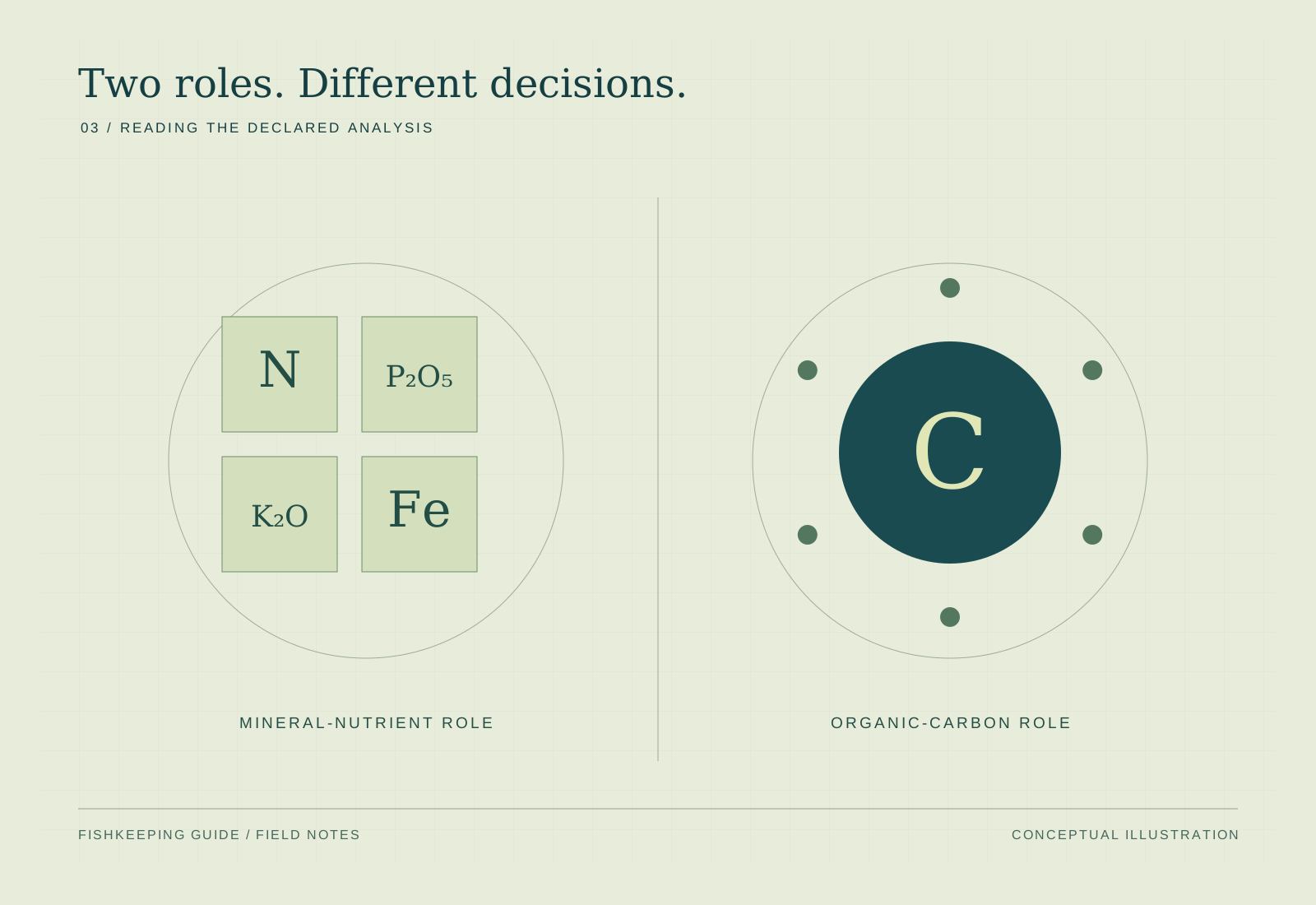
Easy also does not mean no nutrients or carbon. Plants use nutrients through roots, leaves or both, and naturally available carbon can support some lower-demand setups. Added CO₂ is not automatically necessary for every choice here, but this is not a guarantee that any combination of light, water and planting will work without it. Match a feeding and lighting plan to the actual setup; do not compensate for poor growth by changing everything at once.
Check the name, the rules and the next growth
Check local sale, possession and import rules for the exact plant before ordering. US federal restrictions are only one layer; they do not clear a plant for every state or another country. Availability from an overseas shop is not evidence that importing the plant is permitted where you live.
Never release aquarium plants or fragments into waterways or drains. Follow local disposal instructions; Michigan's official guidance calls for sealing unwanted plant material in bags for the trash, not composting it. Record planting dates, trims and changes in growth so the next adjustment has a reason. Keep an aquarium maintenance log so the next trim or planting change has a dated reference.
Sources: USDA APHIS ↗ Electronic Code of Federal Regulations ↗ Michigan Invasive Species Program ↗
Plant descriptions use actual-read Tropica profiles and care manuals. Manufacturer guidance supports the selections; no independent growth trial or product comparison is claimed.
- Tropica: Anubias barteri var. nana ↗Compact size, slow growth, shade tolerance, attachment and exposed-rhizome requirement.
- Tropica: Microsorum pteropus ↗Fern height, hardscape attachment, rhizome division, burial warning and underside sporangia.
- Tropica: Taxiphyllum barbieri 'Bogor Moss' ↗Exact supplied plant name, surface attachment, mat thickness and scissor trimming.
- Tropica: Cryptocoryne wendtii 'Green' ↗Rosette form, variable dimensions and low-lying leaves in an open position.
- Tropica: Bacopa caroliniana plant profile ↗Stem growth, grouping, initial dimensions and propagation with planted side shoots.
- Tropica: Bacopa caroliniana growing guide ↗Background placement, longer-term height, planting and rejuvenation with cuttings.
- Tropica: Helanthium tenellum 'Green' ↗Former Echinodorus name, rosulate foreground role and light/root-nutrition conditions for a carpet.
- Tropica: Echinodorus grisebachii 'Bleherae' ↗Large solitary habit, 20–50 cm description, nutritious bottom and risk of shading neighbours.
- Tropica: Planting ↗Preparation by plant format; stem separation; rooted rosettes; moss attachment and keeping rhizomes unburied.
- Tropica: Trimming ↗Stem cutting and replanting, moss grooming, rosette leaf removal, thinning and runner control.
- Tropica: Light ↗Light received changes with depth, distance and shading; lamp power alone is insufficient.
- Tropica: Fertiliser and CO₂ ↗Plants require nutrients and carbon; uptake routes and relative demands differ. No dosing or universal CO₂ guarantee adopted.
- USDA APHIS: Federal Noxious Weeds ↗Federal plant restrictions and permits; states can impose additional requirements. Not international clearance.
- Electronic Code of Federal Regulations: 7 CFR 360.200 ↗Actual federal noxious-weed list checked as one regulatory layer; does not replace local or foreign checks.
- Michigan Invasive Species Program: Landowners, gardeners and pond owners ↗No release of aquarium plants; bag unwanted plant material for trash rather than compost, following local disposal rules.
- Tropica: Helanthium catalogue results ↗The specific 'Green' product spreads through runners; used alongside its individual profile.