Plan the adult life.
- Temperament
- Active; food competition matters
- Compatibility
- Fast common and comet forms can outcompete slower fancy goldfish. Shared species identity does not make every variety an appropriate companion.
Expect a commitment extending well beyond the small juvenile in a shop. Adult growth, filtration and long swimming space must shape the housing choice.
Start with a sourced care baseline.
Use these published care baselines to start a plan. Read each scope note: group guidance, captive-bred stock and mixed aquariums are not interchangeable. Change water conditions gradually with appropriate advice, not merely to match a number on a page.
- Adult housing baseline
- OATA: at least 100 L for one adult, plus 50 L per additional adultOATA · source guidance ↗
Scope & planning notes
A general goldfish recommendation, not a maximum capacity calculation.
Common/comet fish need substantial length and adult swimming space. Liters alone do not approve a tank.
- Adult dimensions check
- RSPCA: length ≥4×, width ≥2×, height ≥3× adult body lengthRSPCA Australia · source guidance ↗
Scope & planning notes
The source also gives a general 50 L floor and explicitly says active slim forms need larger, longer aquariums.
Use adult dimensions and variety needs alongside volume. Do not advertise the 50 L floor as complete common/comet housing.
- Temperature reference
- RSPCA: 20–24°CRSPCA Australia · source guidance ↗
Sources differ: read scope
General indoor-goldfish ideal range on this source.
OATA instead lists a broad 4–25°C guideline range. These describe different breadths of guidance; do not average them or present cold tolerance as an ideal.
Read the other source ↗ - pH reference
- RSPCA: 6.5–7.5RSPCA Australia · source guidance ↗
Sources differ: read scope
General goldfish ideal guidance.
OATA lists 6.0–8.0. Retain attribution and assess the actual water and fish rather than chasing a blended target.
Read the other source ↗
Plan around the adult fish
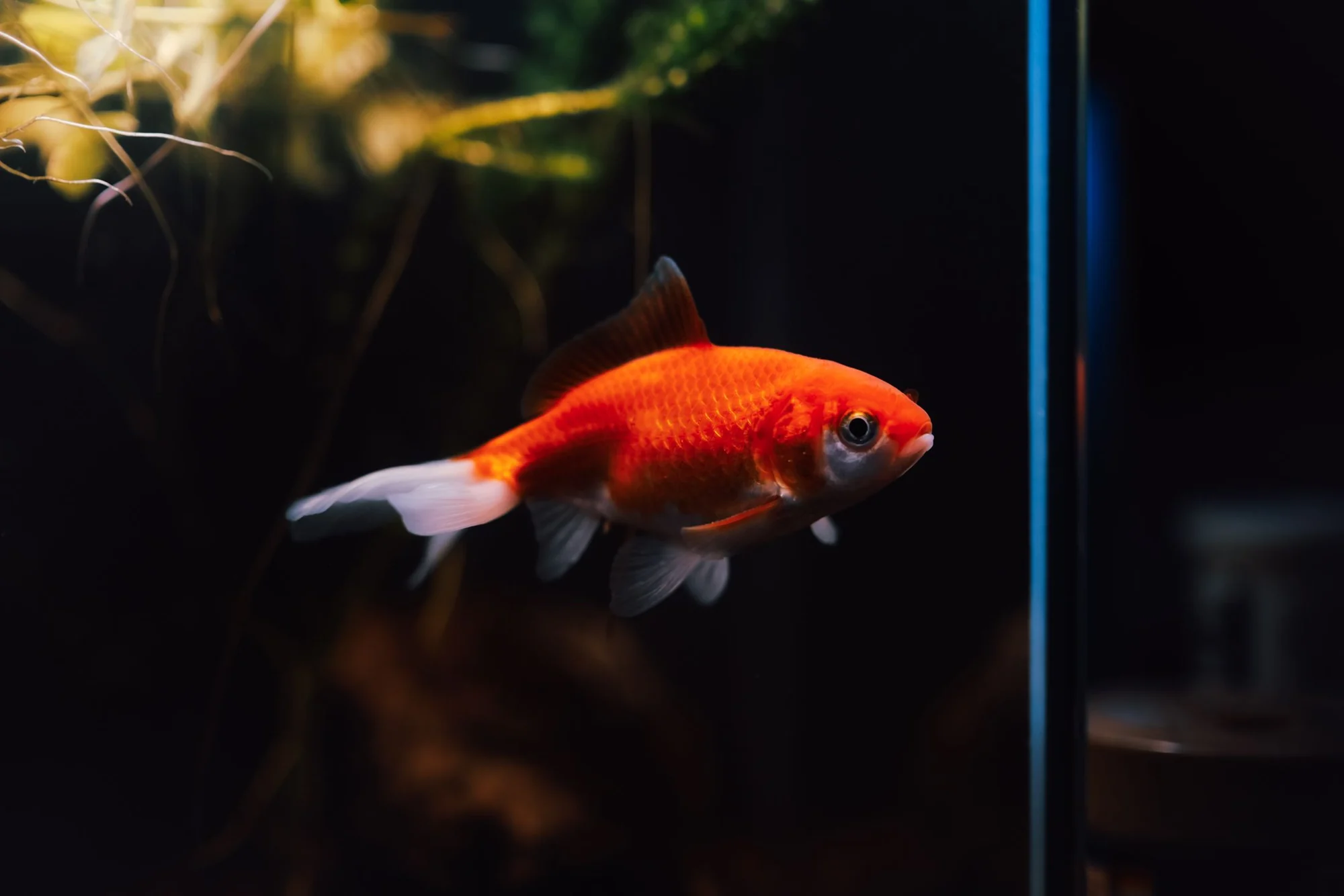
Common and comet goldfish are streamlined forms of Carassius auratus. Their activity and eventual growth make the aquarium's length and usable swimming area important. Choose housing for the adult fish rather than treating the shop's juvenile size as permanent.
Sources: RSPCA Australia Knowledgebase ↗ Ornamental Aquatic Trade Association ↗ Missouri Department of Conservation ↗
Give filtration a real workload
Goldfish produce considerable waste. Provide established biological filtration, regular water testing and maintenance suited to the load. Keep feeding controlled: persistent food-seeking is not a reason to keep adding food, and leftovers can degrade water quality.
Sources: RSPCA Australia Knowledgebase ↗ Ornamental Aquatic Trade Association ↗
Do not collapse all varieties into one
Fancy goldfish have been selectively bred for different body and fin shapes. Some swim or feed less effectively than streamlined comets. Assess companions by swimming ability, feeding access and individual needs rather than putting every goldfish variety together.
Sources: Ornamental Aquatic Trade Association ↗ RSPCA Australia Knowledgebase ↗
Keep the commitment contained
Goldfish can live for many years, so maintenance and future space belong in the purchase decision. If circumstances change, arrange responsible rehoming. Never release a goldfish into a stream, lake or other natural waterway.
Sources: RSPCA Australia Knowledgebase ↗ Missouri Department of Conservation ↗
Before you bring one home.
Have I identified the variety and planned adult housing, effective filtration and routine maintenance for the fish's full life?
A concise species introduction, not a complete breeding, treatment or stocking plan. Sources are linked by section. Exact water and housing targets require species-specific planning.
- RSPCA Australia Knowledgebase: How should I care for my goldfish? ↗Adult-size planning, greater space for active slim-bodied forms, substantial waste, filtration, longevity and variety-specific welfare needs.
- Ornamental Aquatic Trade Association: How to look after goldfish in an aquarium / fish tank ↗Scientific identity, adult growth, filtration, feeding restraint and comet versus fancy feeding competition.
- Ornamental Aquatic Trade Association: How to look after fancy goldfish ↗Fancy varieties share Carassius auratus identity but have different body shapes, care demands and competition risks with common forms.
- Missouri Department of Conservation: Goldfish field guide ↗Scientific identity, selective-breeding differences and the ecological reason never to release aquarium goldfish into natural waters.