Plan the adult life.
- Temperament
- Cichlid; territory can intensify during breeding
- Compatibility
- Small fish can become prey, and breeding fish may defend a site. A quiet juvenile does not establish adult compatibility.
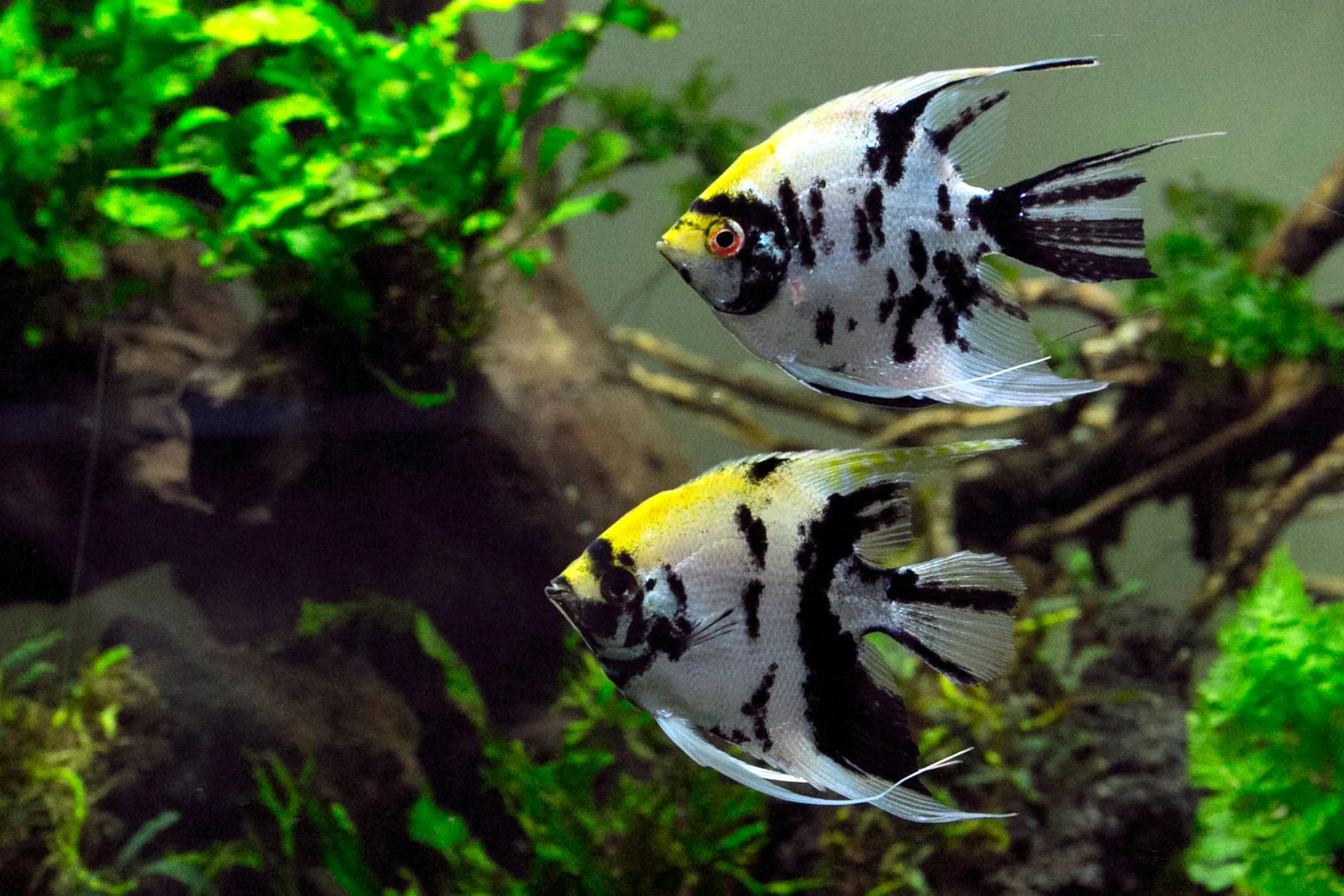
Allow for adult body height and fins as well as length. Confirm the species because other Pterophyllum species and marine angelfish need separate consideration.
Start with a sourced care baseline.
Use these published care baselines to start a plan. Read each scope note: group guidance, captive-bred stock and mixed aquariums are not interchangeable. Change water conditions gradually with appropriate advice, not merely to match a number on a page.
- Temperature
- 78–84°FAqueon · source guidance ↗
Scope & planning notes
Care guidance specifically discusses captive-raised angelfish; most stock is P. scalare.
Do not apply to marine angelfish or assume wild P. altum has the same needs.
- pH
- 6.8–7.8Aqueon · source guidance ↗
Scope & planning notes
The manufacturer's captive-raised-angelfish care baseline.
A stable suitable system matters; this is not an instruction to adjust pH rapidly.
- Carbonate hardness
- 3–8°dKH (54–145 ppm as published)Aqueon · source guidance ↗
Scope & planning notes
Source notation is dKH, not general hardness dGH.
Keep that distinction in labels and test-kit interpretation.
- Adult housing
- 55 US gallons or larger; tall aquariumAqueon · source guidance ↗
Scope & planning notes
Adult housing recommendation; usable height accommodates body and fins.
The source does not assign a fish count to this volume. Breeding aggression and smaller-fish predation still need a plan.
Confirm which angel you are buying
This profile is for Pterophyllum scalare, a freshwater cichlid from South America. It does not describe marine angelfish. Confirm the scientific identity at purchase, especially when a listing uses only a common name or a color-strain name.
Make room for the full shape
The adult fish's tall body and fins need usable height as well as swimming space. Gentle flow, plant cover and suitably arranged vertical wood reflect features of the slow, sheltered waters described in the species' natural history.
Revisit the community as fish mature
Angelfish may consume smaller fish and become more defensive when pairing or spawning. Observe behavior as the fish grow and prepare an alternative arrangement if aggression appears. A compatibility list cannot account for every adult individual or breeding situation.
Support stable daily care
Provide mature filtration, appropriate tropical conditions and regular water-quality checks. Feed a suitable varied diet in controlled portions. Leave access to food at the levels where the fish feed, while checking that smaller or less assertive animals are not excluded.
Sources: Aqueon / Central Aquatics ↗
Before you bring one home.
Can the mature aquarium accommodate the fish's full height, and what happens to smaller companions if a pair begins defending eggs?
A concise species introduction, not a complete breeding, treatment or stocking plan. Sources are linked by section. Exact water and housing targets require species-specific planning.
- National Aquarium: Freshwater Angelfish ↗Pterophyllum scalare identity, South American freshwater habitat, tall body, animal prey in the diet and parental egg guarding.
- Aqueon / Central Aquatics: Angelfish Care Guide ↗Freshwater Pterophyllum identification, adult height planning, gentle flow, cover, filtration, diet, predation and spawning aggression.