Plan the adult life.
- Temperament
- Social; breeding pressure needs planning
- Compatibility
- Avoid companions likely to nip long fins. Mixed-sex groups can produce young, so today's head count may not stay constant.
Plan for the group and possible offspring. Confirm whether the fish is Poecilia reticulata or the distinct Endler species Poecilia wingei.
Start with a sourced care baseline.
Use these published care baselines to start a plan. Read each scope note: group guidance, captive-bred stock and mixed aquariums are not interchangeable. Change water conditions gradually with appropriate advice, not merely to match a number on a page.
- Temperature reference
- OATA guppy/molly guide: 20–28°COATA · source guidance ↗
Scope & planning notes
Joint care guidance, not a uniquely tested P. reticulata optimum.
Confirm suitable stable conditions for the actual stock; the endpoints are not a recommendation to fluctuate.
- pH and general hardness reference
- OATA: pH7.0–8.0; GH8–18°dHOATA · source guidance ↗
Scope & planning notes
Published guppy/molly group guidance describes medium-hard water.
Label as source group guidance. Do not substitute carbonate hardness for GH.
- Housing starting point
- OATA: at least 45 L for a small group of the smaller speciesOATA · source guidance ↗
Scope & planning notes
Conditional group recommendation, with larger volume needed for more groups.
This is not a fixed number of guppies per 45 L; account for adults, offspring and other residents.
- Mixed-sex social plan
- OATA suggests at least 3: two females per maleOATA · source guidance ↗
Scope & planning notes
The source's mixed-sex guppy/molly arrangement to reduce pressure on females.
This is not a requirement to buy breeding fish. Mixed-sex guppies can produce young; plan offspring and avoid crowding.
Look beyond the color name
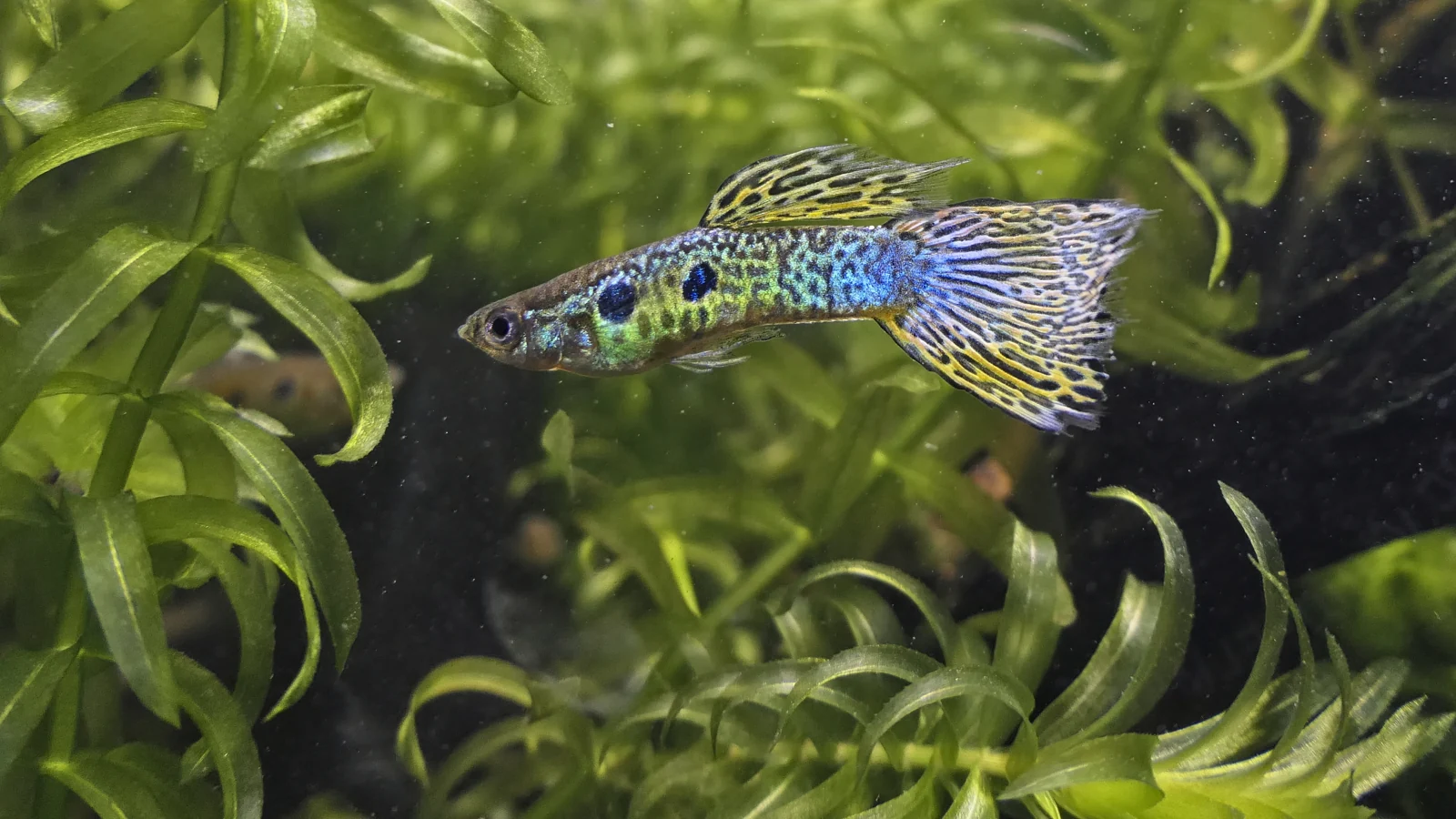
Poecilia reticulata is the guppy covered here. Endler's livebearer, Poecilia wingei, is a different species. Ask the seller to identify the fish and sex the proposed group; a color or tail-strain name does not answer either question.
Sources: Ornamental Aquatic Trade Association ↗ U.S. Geological Survey, Nonindigenous Aquatic Species Database ↗
Build for a small, active group
Provide swimming room, plant cover and gentle flow for long-finned fish. Establish filtration and check the aquarium's water before stocking. Assess hardness as well as temperature instead of assuming that every tropical freshwater setup suits guppies.
Account for the next generation
Guppies give birth to live young and reproduce readily. Discuss group composition and a responsible plan for offspring before buying. Monitor feeding and fin condition, and avoid fish likely to harass or nip the guppies' fins.
Before you bring one home.
Have I confirmed the species and sexes, checked water suitability, and decided how I will manage any offspring without overcrowding?
A concise species introduction, not a complete breeding, treatment or stocking plan. Sources are linked by section. Exact water and housing targets require species-specific planning.
- Ornamental Aquatic Trade Association: How to look after guppies and mollies ↗Guppy versus Endler identity, livebearing, reproduction, companionship, water hardness, gentle flow, cover and fin-nipping caution.
- U.S. Geological Survey, Nonindigenous Aquatic Species Database: Guppy species profile ↗Poecilia reticulata scientific identity and recorded size differences between sexes.