Plan the adult life.
- Temperament
- Territorial; social hierarchy matters
- Compatibility
- Species, maturity and pairing affect aggression. Grouping unrelated clownfish or adding a shy companion needs careful assessment, not a generic reef-safe label.
Prepare a mature marine system and ongoing saltwater maintenance. An anemone is a separate animal with additional requirements, not an automatic companion purchase.
Start with a sourced care baseline.
Use these published care baselines to start a plan. Read each scope note: group guidance, captive-bred stock and mixed aquariums are not interchangeable. Change water conditions gradually with appropriate advice, not merely to match a number on a page.
- Temperature reference
- OATA clownfish guide: 24–26°COATA · source guidance ↗
Scope & planning notes
A general clownfish care baseline covering several species.
Confirm the exact stock and whole-system requirements; mixed reefs may need different parameters.
- pH reference
- OATA clownfish guide: 7.9–8.3OATA · source guidance ↗
Scope & planning notes
The source explicitly labels its chemistry as group guidance.
Do not treat it as a complete reef specification or adjust chemistry abruptly.
- Pair housing baseline
- OATA: at least 60 L for one pair of common/percula clownfishOATA · source guidance ↗
Scope & planning notes
The page explicitly identifies common clownfish (A. ocellaris) and percula as the smaller species for this recommendation.
Larger housing is required with other species. Volume alone does not approve territory, filtration or reef compatibility.
- Social arrangement
- Source recommends a male/female pair, not a groupOATA · source guidance ↗
Scope & planning notes
Clownfish guidance describes a changing dominance/sex hierarchy.
Pairing is not guaranteed. Have a practical response to injury or sustained bullying; do not add a second adult female blindly.
Keep the saltwater distinction clear
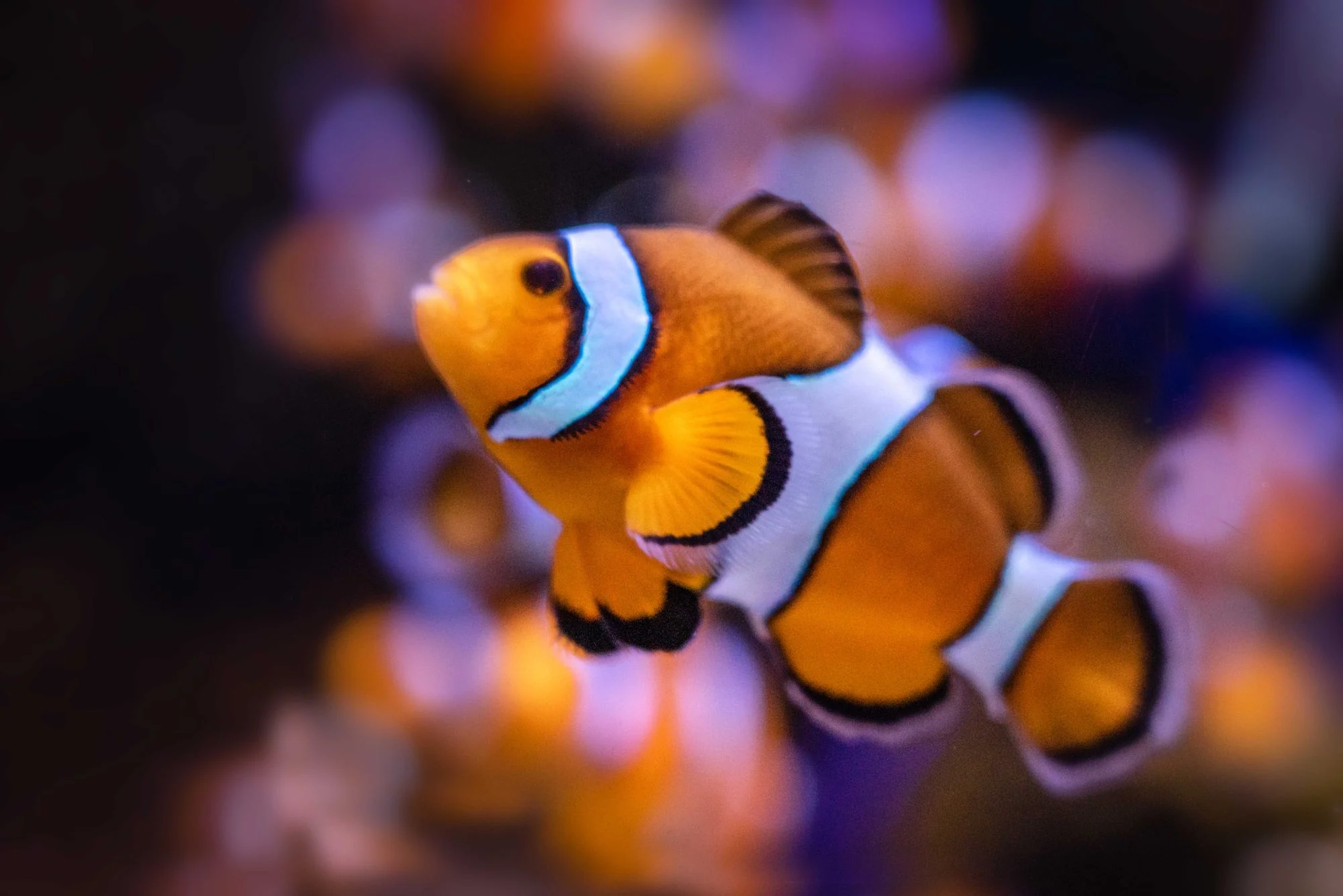
Amphiprion ocellaris is a tropical marine fish associated with reefs. It cannot join a freshwater community. Confirm the species because common names, designer color patterns and similar-looking clownfish can obscure differences in identity and behavior.
Sources: Florida Museum of Natural History, University of Florida ↗ Ornamental Aquatic Trade Association ↗
Maintain the marine system
Use an established marine aquarium with suitable biological filtration and water movement. Measure salinity as well as the usual water-quality indicators, and plan the maintenance and equipment for the whole system, including any corals or other sensitive inhabitants.
Observe the social arrangement
Clownfish have a size-based social hierarchy, and a maturing dominant fish can become female. Territorial behavior and bullying can emerge as relationships change. Confirm the pairing plan with a knowledgeable supplier and monitor the actual fish after introduction.
Sources: Florida Museum of Natural History, University of Florida ↗ Ornamental Aquatic Trade Association ↗
Treat anemones as a separate decision
A captive clownfish does not require an anemone to be kept successfully. Adding one introduces another animal's housing, lighting and compatibility needs. Research those demands independently instead of buying an anemone solely because wild clownfish associate with one.
Sources: Ornamental Aquatic Trade Association ↗ Florida Museum of Natural History, University of Florida ↗
Before you bring one home.
Is my marine system established, can I monitor salinity and water quality, and have I checked the exact clownfish species and proposed social arrangement?
A concise species introduction, not a complete breeding, treatment or stocking plan. Sources are linked by section. Exact water and housing targets require species-specific planning.
- Florida Museum of Natural History, University of Florida: Clown Anemonefish ↗Amphiprion ocellaris identity, marine habitat, common names, anemone association and size-based sex/social hierarchy.
- Ornamental Aquatic Trade Association: How to look after clown fish ↗Marine equipment, salinity monitoring, territorial/pairing concerns and the fact that anemones are not required in captivity.