What do the three kits actually measure?
This is a comparison of manufacturer documentation checked November 10, 2026. We have not tested these kits against reference samples or ranked their accuracy. The table compares named coverage and practical fit, using the specific freshwater products and regional versions identified below.
Which readings are on your list?
Choose the measurements you need. The result checks the listed contents of these exact kits. It does not compare accuracy or establish safe water.
Ammonia, nitrite and nitrate start selected as an editable nitrogen-cycle example. Follow the requirements of your actual aquarium.
API Freshwater Master Test Kit
US product documentationAll selected readings are listed.
NT Labs Aquarium Lab Multi-Test
UK product documentationAll selected readings are listed.
Tetra EasyStrips 6-in-1 Aquarium Test Strips
US model, distinct from European Tetra Test 6in1Not listed: Ammonia
The full comparison table and source links below remain available.
| Specific product | Format | Documented coverage | Important gap | Consider it when |
|---|---|---|---|---|
| API Freshwater Master Test Kit, US product page | Liquid reagents and colour charts | Ammonia, nitrite, nitrate, pH and high-range pH | No GH, KH or chlorine test in the listed contents | You need those core readings and can add any missing hardness tests. |
| NT Labs Aquarium Lab Multi-Test, UK product page | Liquid drop tests | Ammonia, nitrite, nitrate, pH, GH and KH | No chlorine test listed; nitrogen results use an N-based reporting convention | Your freshwater plan needs hardness readings alongside the nitrogen-cycle tests. |
| Tetra EasyStrips 6-in-1, US model | Colour-comparison strips | Nitrate, nitrite, GH, total chlorine, alkalinity/KH and pH | No ammonia test; not the same model as European Tetra Test 6in1 | You want this strip workflow and have a separate way to measure ammonia. |
Choose for the aquarium you are checking.
For a new freshwater aquarium following a fishless cycling method, list ammonia and nitrite explicitly. Nitrate is a different measurement; a nitrate result cannot stand in for an ammonia result. Use the cycling method's required tests and interpretation. A strip that omits ammonia cannot provide that reading, however reassuring its other colours look.
For species planning, add the water measurements relevant to those animals. GH describes calcium and magnesium hardness; KH concerns buffering. Neither is another name for pH. The API GH and KH kit is a separate product, so an owner of the Master kit may only need to fill that gap. There is no need to buy an entire second bundle simply to make all the boxes look alike.
For marine or brackish water, check the exact test's stated scope. This comparison does not select a complete reef kit. Tetra publishes a saltwater chart for its US strips, but specifically excludes the GH pad from saltwater interpretation. NT Labs advises using its marine tests for brackish water.
Ammonia, ammonium and TAN: read beyond the abbreviation.
Ammonia in water includes unionised NH3 and ionised ammonium, NH4+. A total-ammonia measurement covers both forms. The proportion present as NH3 depends on conditions including pH and temperature. API's ammonia guidance identifies its liquid ammonia tests as total-ammonia tests. A total reading is not a direct measurement of the NH3 fraction alone.
Keep two questions separate: which chemical forms does the method detect, and how does the chart express the concentration? A result reported as nitrogen, often written with an N suffix, is not numerically interchangeable with every result labelled ammonia. NT Labs documents nitrogen-based reporting. Its NH3-N label should not be read as proof that the kit measures only free NH3. Copy the analyte, unit, reporting basis and kit name into your care record.
Different nitrate numbers may use different reporting bases.
Nitrite, NO2, and nitrate, NO3, are separate analytes. Then check whether each concentration is expressed as the whole species or as its nitrogen content. Writing only 'nitrate: 10 ppm' leaves information out when comparing charts, brands or a water-supplier report.
Here is a reporting example, not an aquarium target: 10 mg/L nitrate as nitrogen, written NO3-N, corresponds to about 44.3 mg/L expressed as NO3 using NT Labs' stated factor of 4.43. That arithmetic does not mean the aquarium became more polluted. It describes the same quantity on a different reporting basis. Do not apply the nitrate factor to nitrite or ammonia.
NT Labs' Multi-Test page explicitly lists NH3-N, NO2-N and NO3-N reporting. Tetra's US chart labels its nitrogen-cycle fields as nitrate and nitrite in ppm, with mg/L alongside. Verify the chart for the actual box and ask the manufacturer if its basis is unclear before comparing a borderline result.
Will the testing routine fit the way you work?
For liquid tests, make room for clean tubes, the correct sample volume, individual reagent steps and a timer. API distinguishes vigorous shaking of indicated reagent bottles from gentler mixing of capped sample tubes. Follow each test's directions rather than treating every bottle in the case as the same procedure.
Instructions can change with formulation. NT Labs now documents a two-reagent ammonia test, replacing its older three-reagent formulation. Its current standalone nitrate instructions also require deliberate mixing and a timed wait. Match the leaflet to the bottles you actually own instead of copying the first video tutorial you find.
The US Tetra EasyStrips directions say to keep the strip level for the reading and not shake away the excess water. European Tetra Test 6in1 instructions describe different handling. Similar branding is not a reason to swap instructions. Keep the container closed and use the supplied printed chart; Tetra warns that on-screen chart colours differ from the bottle's printed reference.
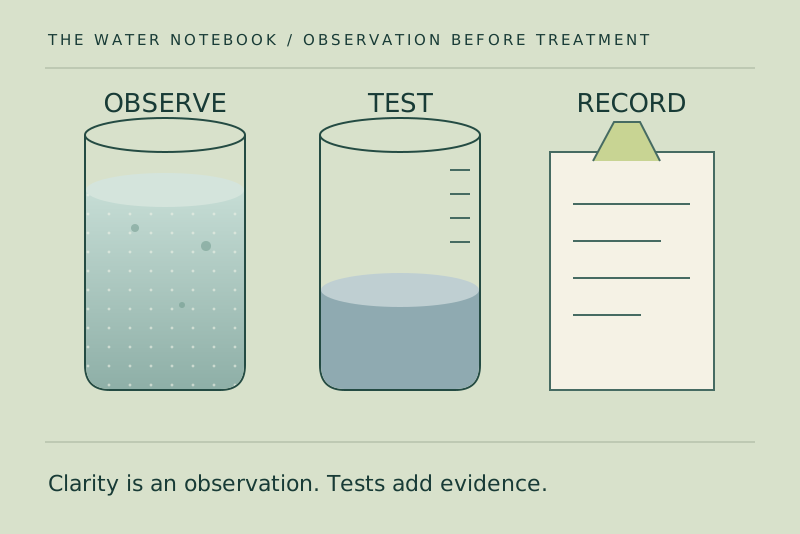
During a test, record aquarium or source water, the time, kit and result. Keep reacted samples out of the tank and follow the product's handling and disposal instructions. If a result is unexpected, check the procedure and repeat with a fresh sample while also checking the fish and equipment.
What does a reassuring set of colours leave unanswered?
None of the three listed sets includes a dissolved-oxygen or temperature measurement. None identifies a fish disease. Their published coverage is not a screen for every contaminant, medicine or metal that could matter. A chlorine field also needs its own method and interpretation; it does not replace correct preparation of replacement water.
The table cannot tell us which kit gives the closest result to a reference laboratory, which is easiest for a person with colour-vision difficulty, or which performs best under every lighting condition. Those questions need evidence beyond the manufacturers' descriptions. If colour matching is difficult, arrange a suitable reading method or professional demonstration before relying on a purchase. Unusual breathing, loss of balance or rapid decline belongs in the fish-help flow even when the colours seem normal.
Check the cupboard before the checkout.
Make a short inventory: tests already owned, usable reagents or strips, legible charts and the readings still missing. Check the actual containers' expiry and storage instructions. The expiry date of the unit a seller will ship is unknown here. An incomplete or poorly stored bargain may leave you buying the same test again.
Compare the complete shopping requirement, including separate tests you need. NT Labs advertises up to 200 tests combined, which does not mean 200 complete six-parameter panels. Prices, delivered costs and comparable cost-per-panel are not verified for this article. A lower sticker price cannot settle that comparison without the pack contents and your testing pattern.
Use the manufacturer product pages and dealer routes to confirm the exact model. Retailer searches can return a refill, a different regional version or another kit from the same brand. Once your chosen set covers the job, the useful next step is learning its procedure and keeping a dated record.
The method is stated at the beginning of the comparison. Sources identify named product coverage, instructions and reporting conventions. Stock, delivered price, unit expiry and comparative performance remain unverified.
- API: Freshwater Master Test Kit, US product documentation ↗Named freshwater coverage, reagent mixing and tube-cleaning information.
- NT Labs: Aquarium Lab Multi-Test ↗Freshwater test coverage, nitrogen-based reporting and combined test count.
- Tetra: EasyStrips 6-in-1 Aquarium Test Strips, US model ↗US product page and Instructions tab checked November 10, 2026, with the linked chart below.
- Tetra: US EasyStrips freshwater and saltwater comparison chart ↗US freshwater/saltwater chart; GH is excluded from saltwater interpretation. Use the supplied printed chart for reading tests.
- API: General and Carbonate Hardness Test Kit ↗Separate GH/KH test coverage and the distinction between hardness and pH.
- API: Ammonia testing for water quality ↗Total-ammonia measurement and the influence of pH and temperature on its forms.
- NT Labs: Water quality parameters in freshwater aquariums ↗Water-quality analytes and ammonia/ammonium reporting.
- NT Labs: Current Aquarium Ammonia Test instructions ↗Two-reagent standalone ammonia formulation and nitrogen-based reporting. Match instructions to the actual bottles.
- NT Labs: Aquarium Nitrate Test instructions ↗Nitrate method, nitrogen reporting basis and the 4.43 conversion factor.
- Tetra: European Test 6in1 instructions, English section ↗Older European model instructions, used only to distinguish its handling from US EasyStrips.
- OATA: How to test freshwater aquarium water quality ↗Freshwater water-testing practice and the value of checking the fish alongside readings.
- API: Official store locator ↗Official retailer directory; stock and prices require a separate check.
- NT Labs: Worldwide stockists ↗Official international stockist directory; entries and availability can change.